Overview
We are in the early design stages of an electric SWATH passenger vessel, providing a high-comfort platform in year-round coastal conditions for tourism and commuter routes.
Our decision to pursue a SWATH design comes from two strategic questions.
First, which applications are realistic early candidates for electric propulsion? For our organization, the most practical near-term opportunities fall into two categories: long, slow coastal voyages that can leverage solar power to operate with minimal infrastructure, and short, predictable routes with fixed terminals and predictable charging cycles. Ferries, tourism vessels, and commuter routes fall into the second category. They do not depend on widespread charging networks, and their operating patterns allow propulsion and energy systems to be optimized around known conditions.
Second, which hull design choices are best suited to take advantage of electric propulsion, given its dramatically different constraints when compared to diesel? We are not interested in simply placing electric motors in vessels designed for diesel engines. We would like to determine which new (or existing) designs best fit the strengths and weaknesses of electric systems.
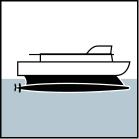
One hull form that we believe has been under-exploited in the diesel era is the SWATH (Small Waterplane Area Twin Hull), a concept pioneered by Frederick G. Creed and demonstrated aboard the Canadian Coast Guard vessel of the same name. The SWATH is similar to a catamaran, but with hulls optimized for passenger comfort with reduced motion. Like a hydrofoil, a SWATH’s passenger compartment rides above the waves and is minimally affected by them. However, instead of using wing foils that produce lift at speed, a SWATH relies on static buoyancy - it is to a hydrofoil what a blimp is to a plane.
A SWATH carries most of its displacement in submerged, torpedo-shaped hulls below the waterline, connected to the above-water platform by narrow struts. The passenger cabin sits above. Because only the struts interact with the surface of the water, a SWATH stays exceptionally level in waves, whether moving or at rest.
In the diesel world, however, SWATH designs faced practical limitations. The ideal location for mass in a SWATH, including propulsion, is within the submerged torpedoes. Diesel engines complicate that arrangement. They require air intake, exhaust routing, regular human access for maintenance, and significant cooling systems. Making this layout workable often pushes SWATH vessels toward larger sizes, where space and access constraints are less severe.
Electric propulsion changes that equation. Electric motors can operate in sealed pods, batteries can be distributed low in the hull, cooling requirements are reduced, and maintenance needs are significantly lower. This makes it far more practical to place propulsion systems within the submerged hulls and opens the possibility of smaller SWATH vessels with simpler mechanical layouts.
This shift opens the possibility of smaller SWATH vessels with simpler mechanical layouts and a cleaner structural separation between underwater systems and the above-water platform. Propulsion, energy storage, and stability can be optimized below the waterline, while the topside can remain adaptable to specific missions. That modular separation is important to our broader goal of advancing technology in ways that others can build upon.
SWATH designs are not universally superior. They are sensitive to large load changes, such as those encountered in fishing or cargo-carrying operations. They typically operate at lower speeds than hydrofoils, require a larger overall footprint relative to usable interior space, and are not well-suited to shallow-water environments. Like any specialized hull form, they must be tuned carefully to their intended application.
Given those trade-offs, our research explores whether:
- Electric propulsion makes SWATH viable at smaller scales. This includes motors and batteries in sealed, passively cooled “torpedos” below the waterline.
- Modular separation of hydrodynamically active hulls and drive systems from the passenger and crew areas above creates design and application flexibility, enabling wider adoption.
- Comfort, quiet operation, and stability can become meaningful advantages that make early electrification compelling on their own merits.
Our approach is incremental. We are targeting a 75’ SWATH vessel but will begin with a quarter-scale prototype designed for one or two passengers and use it to validate stability, control, propulsion integration, and energy distribution concepts. As the quarter-scale prototype is completed, we plan to share our findings openly.